Sunday, 8 November 2026

Taito Chase H.Q. (Sega Master System review)

Developer: Taito
Publisher: Sega Enterprises, Ltd.
Released: 1990

Taito Chase H.Q. is an action-driving game that was originally released in the Arcade in 1988.

+ Action is blisteringly fast with an excellent frame-rate throughout, and the post-mission arrest screens are a great reward.

+ It's a rush when you get a criminal in your sights, and systematically destroying their car against the strict timer is thrilling.

+ Ability to upgrade your vehicle aides strategy, especially as the expensive Super Charger requires thrifty spending to afford.

- Ultimately, the gameplay is a one-trick pony and once you've seen a couple of stages it essentially has nothing else to offer.

- Car handling changes dramatically when approaching a tunnel and your vehicle suddenly feels like it's on an ice rink.

- Provides minimal detail about each criminal, so it's hard to get too invested in their story and bringing them to justice.

- Gameplay loops after just five brief stages, and the dreadful music consists of rudimentary bloops and bleeps.


Tuesday, 10 June 2025

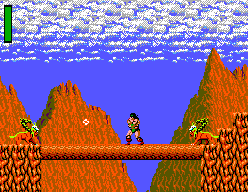
Toki (NES review)

Developer: Taito
Publisher: Taito
Released: 1991

Toki is an action-platformer that was first released in the Arcade in 1989.

+ Great level design with a nice assortment of enemies, environmental hazards and stage verticality to mix things up.

+ Ample chances to power-up and while the 1992 Atari Lynx / Sega Genesis ports had one-hit kills this game adds a health bar.

+ Solid controls and your ability to fire diagonally opens up your attack arsenal and protects you from airborne enemies.

+ Cool stage intros resemble Ghosts 'n Goblins (1986, NES) and the gigantic bosses are enjoyable to fight.

- As a lead character, Toki is lacking in personality and charm, especially when compared to Bonk (Turbografx-16).

- Often has severe sprite flicker that distracts, and although there's a wide range of enemies they're rather unimaginative.

- Minecart section in the finale is laden with funky jumping physics and the collision detection takes a nosedive.


Sunday, 27 October 2024

Qix (NES review)

Developer: Novotrade International
Publisher: Taito
Released: 1991

Qix is an action game that was first released in the Arcade in 1981.

+ Maddeningly addictive gameplay and there's plenty of catchy jingles that act as a reward for beating levels.

+ Considerable amount of techniques you can employ to fill the screen, so you always have new strategies to try out.

+ Sparx are brilliantly devious, as they stop you from moving safely by chasing your lines around the playfield.

+ A and B buttons allow you to move fast or slow, with the latter adding risk-reward due to it gaining you more points.

- Light on gameplay options, and the sharp increase in difficulty could deter some players from sticking around.

- Missed opportunity to house a showcase co-op mode, as the included two-player option is turn-based only.

- While there's a huge number of levels, the core gameplay remains the same throughout, with no major shake-ups.


Thursday, 24 October 2024

The Jetsons: Cogswell's Caper! (NES review)

Developer: Natsume
Publisher: Taito
Released: 1992

The Jetsons: Cogswell's Caper! is an action-platformer based on the animated TV show The Jetsons.

+ Level design is decent and there's some interesting ideas such as reversed gravity and switching between dimensions.

+ Opening level features some in-game tutorials to get you used to the controls and gameplay mechanics.

+ Slowly introduces new power-up mechanics to progress the gameplay, and there's some excellent boss battles.

+ Music is delightfully catchy and there's some gorgeous background sprite detail that adds depth to the surroundings.

- Core gameplay is derivative of Chip 'n Dale Rescue Rangers (1990, NES) and there's little here to differentiate it.

- Controls are stiff and attempting to reverse course in mid-air or make pixel-perfect adjustments is dicey.

- Has some abrupt difficulty spikes that can quickly drain your lives, and the checkpoint spacing can be annoying.


Friday, 12 July 2024

Rainbow Islands (NES review)

Developer: Taito
Publisher: Taito
Released: 1991

Rainbow Islands is a 1987 Arcade game that additionally saw a European exclusive NES port by Ocean (1991).

+ Bite-sized levels encourage you to keep trying and there's a real satisfaction to conquering a tough stage.

+ Bonus items scattered around the playfield are a tantalising risk-reward tease for high score chasers.

+ The scoring system is deceptively deep and mastering advanced rainbow attacks can net you huge scores.

+ Controls feel tighter and more precise than the Ocean release, particularly when attempting to adjust in mid-air.

- However, this port is less faithful to the Arcade original in terms of level design and intermission screens. 

- Screen doesn't continually scroll as you advance upwards as it pauses a few times per level which breaks immersion.

- SFX are ear-piercingly shrill and the graphics feature less-detailed sprites than the European NES version.


Monday, 18 March 2024

Power Blade (NES review)

Developer: Natsume
Publisher: Taito
Released: 1991

Power Blade is an action-platformer that was released in Japan as Power Blazer (1990).

+ Levels are intricately designed, and their non-linear layouts encourage you to explore in the hunt for the required key cards.

+ Can choose the order in which you tackle the first six stages and there's even a password system to continue your progress.

+ Being able to throw your boomerang in eight directions while jumping is handy for dispatching enemies in tough spots.

+ Managing to locate the Power Suit in each stage is rewarding, as it gives you the tactical benefit of shooting through objects.

+ Includes a wide range of enemies that force you to rethink tactics due to their interesting attack patterns.

- Enemies respawn at an infuriating rate and there is an element of backtracking in order to locate items.

- Character walking animation is rather goofy and the boss battles offer little in the way of resistance.


Saturday, 1 April 2023

The Ninja Warriors (Mega CD review)

Developer: Aisystem Tokyo
Publisher: Taito
Released: 1993

The Ninja Warriors is a beat-em-up that was originally released in the Arcade in 1987.

+ Like Kung Fu (1985, NES), much of the fun comes from learning patterns and quickly executing attacks to defeat enemies.

+ Enemy types are slowly introduced to keep things fresh and some of their powerful projectiles require nimble strategies.

+ Several stages give you the option of choosing multiple routes, which is great for repeated play-throughs.

+ Mega CD arranged music is outstanding and does an amazing job of driving the action while upping the tension.

- Sewer stage design is lacklustre with many copy/paste areas that force you to slowly trudge along while ducking.

- Can be repetitive once you reach the later stages, especially as there's no power-ups or new weapons to boost your attacks.

- Bland bosses are duplicated far too often throughout the game and the final opponent is a complete let-down.


Sunday, 5 March 2023

Rainbow Islands Extra (Sega Mega Drive review)

Developer: Aisystem Tokyo
Publisher: Taito
Released: 1990

Rainbow Islands Extra is an updated version of Rainbow Islands: The Story of Bubble Bobble 2 (1987, Arcade).

+ Bite-sized levels encourage you to keep trying and there's a real satisfaction to conquering a tough stage.

+ The Extra mode provides value-for-money, as it rearranges a number of things such as enemy types and music. 

+ Gradual introduction of new bad guys keeps things fresh and forces you to think about your movements more carefully.

+ The scoring system is deceptively deep and mastering advanced rainbow attacks can net you huge scores.

+ Bonus items scattered around the playfield are a tantalising risk-reward tease for high score chasers.

- The controls can take a while to adjust to, and your inability to fully adjust mid-jump can result in lost lives.

- Slowdown is rampant is later stages which delays button presses and increases the already high level of difficulty.


Rainbow Islands: The Story of Bubble Bobble 2 (Sega Master System review)

Developer: Taito, I.T.L
Publisher: Sega
Released: 1993

Rainbow Islands: The Story of Bubble Bobble 2 is based on the 1987 Arcade game and was only released in Europe and Brazil.

+ Completely different level design to the original, with more variety in both its backdrops and stage layouts.

+ Levels are broken up into sections (e.g. not constantly scrolling) which gives each area a distinct feeling and challenge.

+ Bonus items scattered around the playfield are a tantalising risk-reward tease for high score chasers.

+ The scoring system is deceptively deep and mastering advanced rainbow attacks can net you huge scores.

+ Hit boxes are a little more consistent than the Sega Mega Drive version (1990), and the difficulty is more forgiving.

- The game engine feels like it's running in perpetual slowdown, and the constant sprite flicker is distracting.

- European version of the game features a severe bug that renders the final world completely unplayable.


Tuesday, 7 February 2023

On the Ball (SNES review)

Developer: Taito
Publisher: Taito
Released: 1992

On the Ball is a ball rolling game that was originally released as Cameltry (1989, Arcade).

+ 100 stages are available, so there's plenty to keep you occupied and the inclusion of 3 credits per world is generous.

+ Multiple paths throughout the stages results in increased replayability as you attempt to beat your high score.

+ Scattered time bonus items add a risk-reward element as to whether it's worth obtaining them due to the ticking clock.

+ Controls are spot-on (affording you extreme precision) and the ball physics are surprisingly accurate.

- Offers nothing new after the first world and the difficulty pacing is wildly inconsistent as you progress.

- Some gimmicks tend to frustrate rather than entertain, such as the reverse gravity that flips your controls.

- Game doesn't remember your progress after beating a world, so you must enter a password at the title screen to continue.


Wednesday, 23 March 2022

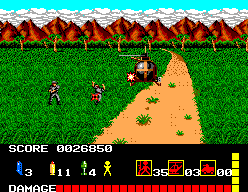
Operation Wolf (Sega Master System review)

Developer: Taito
Publisher: Taito
Released: 1990

Operation Wolf is a light gun game that was only released in PAL territories.

+ Having to conserve ammo for certain situations and using the grenades at opportune moments adds tension.

+ Some gameplay variety is included to spice things up, such as needing to protect civilians as they cross the screen.

+ Multiple endings are available depending on how you perform which is an incentive to replay.

+ Light Phaser allows you to zoom across the screen in a similar fashion to a mouse for increased speed and accuracy.

- However, your arm will quickly ache from repeatedly pressing the trigger and the accessory can't handle rapid fire.

- The Control Pad is either too slow or erratic to use for moving the on-screen cursor and it's not reliable enough.

- Only six brief stages are on offer, which does limit the amount of time you'll likely spend with the game.


Sunday, 6 March 2022

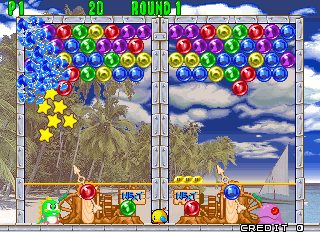
Puzzle Bobble 2 (Neo Geo MVS review)

Developer: Taito
Publisher: Taito
Released: 1999

Puzzle Bobble 2 is a tile matching puzzle game and the follow-up to the 1994 original (Neo Geo MVS).

+ Huge visual overhaul from the original with more detailed backgrounds and larger character sprites.

+ Ability to choose your route through the single player mode provides plenty of reasons to return and see a different ending.

+ Stage layouts are no longer a set width and these larger play-fields test your aim in new, exciting ways.

+ Some later stages feature very clever puzzles that force you to think outside the box.

+ The controls are rock-solid and the aim assist when you lose a life eases frustration by encouraging you to try again.

+ The new CPU battle mode leads to enhanced replayability, and the cut scenes add charm and personality to each opponent.

+ Music strikes a perfect balance of being catchy and relaxing, while also keeping the action suspenseful.


Friday, 4 March 2022

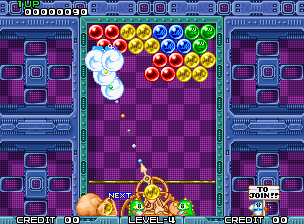
Puzzle Bobble (Neo Geo MVS review)

Developer: Taito
Publisher: Taito
Released: 1994

Puzzle Bobble is a tile-matching puzzle game that's also known as Bust-a-Move.

+ Controls are super responsive meaning every mistake is your own fault.

+ Addictive gameplay, and successfully ricocheting a ball into a crowded area is endlessly entertaining.

+ Good learning curve and eases new players in gently.

+ Two-player mode makes for some fun, impassioned battles.

+ Music is extremely catchy (and cleverly speeds up when you're in danger), while the voice samples add tons of personality.

- No option to battle against the CPU which does restrict some of the enjoyment when playing solo.

- Background graphics are generally dull, repeated tiles.


Monday, 10 January 2022

Rastan Saga (Sega Game Gear review)

Developer: Taito
Publisher: Taito
Released: 1991

Rastan Saga is an action game that was released on the Sega Master System in 1989 under the title Rastan.

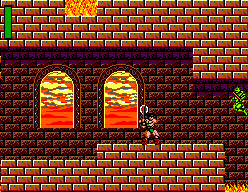
You play as a bounty hunter and your quest is to rescue the King's daughter from the thieves of Semia. While your default weapon is a sword additional items such as axes can be obtained, as well as armour that reduces damage. Unlike most console-to-handheld ports of the time, the playfield isn't zoomed-in to accommodate for the smaller screen; while this does allow you to see the entire surroundings it can be tough to spot hazards such as wall spikes. There is some verticality to mix-up the side-scrolling, but the level design leaves a lot to be desired and apart from minor scenic changes and colour palette switches each stage tends to blur into the next without introducing anything substantially new in terms of environmental hazards or enemy types. The only real difference is trickier platforming that doesn't lend itself well to the stiff controls, as you can't adjust in mid-air. The controls do afford you some great features though and I like how you can perform both small and large leaps, or slash in all four directions depending on which way you press the d-pad, as it gives you a chance in any situation. Some of the weapons are fun too, especially the Fire Sword which allows you to take out enemies from distance. There's also some enjoyment to be had once you've mastered the wall jumping mechanic, as many items are located on top of perilous platforms which adds a risk-reward element. The only other changes from the Master System version are minor, but I appreciate the improved readability of the in-game text and how items now appear in a bordered box for a more polished look.

Rastan Saga is a more refined version of the game compared to its console big brother, but the improvements are marginal at best and little effort has been put into adapting the action for the smaller screen. The combat is excellent though and the fun weapons ensure you're always suitably prepared for battle.


Random trivia: This handheld port was only released in Japan.

Friday, 7 January 2022

Rastan (Sega Master System review)

Developer: Taito
Publisher: Sega
Released: 1989

Rastan is an action game that was later ported to the Sega Game Gear in 1991.

You play as a bounty hunter and your quest is to rescue the King's daughter from the thieves of Semia. While your default weapon is a sword additional items such as axes can be obtained, as well as armour that reduces damage. While there is some verticality to mix-up the side-scrolling, the level design leaves a lot to be desired and apart from minor scenic changes and colour palette switches each stage tends to blur into the next without introducing anything substantially new in terms of environmental hazards or enemy types. The only real difference is trickier platforming that doesn't lend itself well to the stiff controls, as you can't adjust in mid-air to perfectly line up with your chosen location. The controls do afford you some great features though and I particularly like how you can perform both small and large leaps, or slash in all four directions depending on which way you press the d-pad, as it gives you a chance in any situation. Some of the weapons are fun too, especially the Fire Sword which allows you to take out enemies from distance. There's also some enjoyment to be had once you've mastered the wall jumping mechanic and managing to safely navigate a previously impossible area to collect a power-up is hugely rewarding; many of these are located on top of perilous platforms which adds a neat risk-reward element. However, there are times where you'll try to obtain an item, only for your sprite to weirdly pass straight through it. The music is average (if not a bit repetitive), but the bosses include some impressively large sprites and terrific use of the console's colour range.

Rastan is a bit rough around the edges with its cumbersome controls that mar the overall experience, but at its core it's a decent action game with some excellent combat mechanics that give you options at every turn. The level design could have used some extra care though, as what's here can seem very copy-pasted throughout.


Random trivia: The game supports the FM Sound Unit for enhanced music.

Sunday, 26 December 2021

Operation Wolf (NES review)

Developer: Taito
Publisher: Taito
Released: 1989

Operation Wolf is an action game that uses either the NES controller or light-gun Zapper.

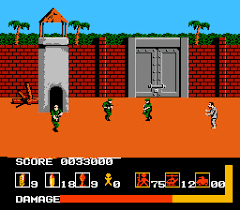
Terrorists have kidnapped American Embassy officials and you must locate the jungle stronghold to complete your rescue mission. You're armed with a machine gun and grenades, and bonus items can be shot to gain things such as additional ammo or dynamite that blows up all enemies on screen. Using the Zapper allows you to quickly move your sight in a similar fashion to a mouse, but the major downside is that enemy vehicles need several hits to destroy and the technology in the accessory cannot handle rapid fire; this results in you continuously pulling the trigger for single shots until repetitive strain injury sets in halfway through the first stage. There's also an accuracy issue, as shot locations are slightly off compared to other Zapper games. The controller is more comfortable as it allows for rapid fire, and I like how there's several options to dial-in the cursor's sensitivity; unfortunately, it suffers from the same accuracy problem, as the hit boxes often don't reflect where you're aiming. There's a nice mixture of enemy types to grab your attention though and you're constantly having to manage firing vs ammo conservation. However, enemies swarm in packs throughout every moment of every stage; not only is this very challenging, it also doesn't engage players as much as it could have due to the lack of calmer moments to build up the intensity. Your life doesn't refill after most completed levels, which is probably an attempt to disguise how short the entire game is at just six stages. The music and SFX are weak, but I like the cut-scenes and multiple endings based on how you perform.

Operation Wolf has short-term appeal if you're looking for a rather mindless shooter, but those hoping for something a bit more tactical or diverse are unlikely to find anything here that suits. The Zapper functionality is completely unusable too, and the inaccurate hit boxes of either control type leaves a sour taste.


Random trivia: The Japanese version allows you to choose which order to play the stages.

Sunday, 12 December 2021

Puzzle Bobble VS (Nokia N-Gage review)

Developer: Taito
Publisher: Jack Of All Games, Nokia
Released: 2003

Puzzle Bobble VS is an Arcade colour-matching puzzle game that's also known as Bust-a-Move.
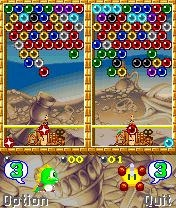
There's two modes (Story and VS) and the aim is to fire bubbles upward and group three or more of the same colour together in order to make them pop. Right from the start, it's clear that the transition to handheld has not been a good one, as the gameplay is sluggish and it takes an absolute age to move your cursor from side-to-side. Also, your cursor is so tiny that it's extremely difficult to gauge the exact direction it's facing, meaning you have to place the N-Gage closer to your face at times to get a better look! In my opinion, it would have been better to include a Solo mode where your playfield takes up the entire screen, rather than here where a portrait LCD is split in two for yourself and your opponent. Additionally, it's likely that you will strain your eyes trying to decipher which colour you currently possess, as (for example) greens, blacks and purples can all look alike due to the zoomed-out nature of the action. Story mode sounds like it could offer something fairly in-depth, but in actuality it only consists of six matches that can be beaten in around 20 minutes total. The cut-scenes displaying your opponent are excellent, but with no dialogue they lack personality and do nothing to advance the narrative. There are some voice clips, but the iconic: "Ready, GO!" phrase at the start of each round is only shown as text. VS mode is slightly more interesting, as you can play with a friend over Bluetooth; however, the same problems above persist. Overall, there's a distinct lack of presentational flair and instead you're greeted with several text-only menus when booting up the game and zero sound until the first battle commences.

Puzzle Bobble VS is technically incompetent and unless you're keenly focused on head-to-head battles with a friend there's really nothing here that will hold your interest for more than an hour. Do yourself a huge favour and stick to the far superior Bust-a-Move Pocket (1999, Neo Geo Pocket Color) version instead.


Random trivia: Taito Memories, a compilation of previous Taito games was in development for the N-Gage before ultimately being cancelled.

Wednesday, 24 May 2017

Arkanoid (NES review)

Developer: Taito
Publisher: Taito
Released: 1987
 

Arkanoid is a brick-breaking game that was originally released in the Arcades in 1986.

 
There's 36 rounds that support either a standard controller or the Vaus spinner controller. The object is to continually bounce a ball off your spacecraft in order to break all of the coloured and silver bricks. In a nice twist, capsules occasionally fall from broken bricks, and if collected they give you super powers such as the ability to catch the ball, split it into three, or even fire a laser to smash the playfield to pieces. The latter is satisfying (helping you clear bricks much quicker) and the weapon system is a really great advancement for the genre. The stage design is a mixed bag; on one hand, Round 5's Space Invader layout is a treat, as is Round 10's L-shaped section where you wedge the ball inside and look to split it into three for utter carnage! Others are less fun, particular Round 3 with its low barrier of unbreakable bricks (in my opinion, this is too challenging for an early stage), and most of the later tedious rounds where every single brick needs to be hit multiple times. The challenge is wildly uneven throughout and the game really could have used some difficulty settings; using a Vaus controller does help due to its variable speed (the one-speed movement of a standard controller is useless) but even then, seeing past the opening rounds is tough. If you do manage to progress to the higher rounds, it's hard not to shake the feeling that you've seen it all before, and the level design starts to look very similar. The only respite is the inspired Round 36 where you manoeuvre your ship to avoid being shot by a boss; it's a wonder why the developers didn't add more of these to break up the action!
 
Arkanoid is a great update of the classic Breakout formula, but it's hard to enjoy the game when it repeatedly beats you over the head with its extreme difficulty. In my opinion, there are Arkanoid clones, such as Crack-Up! (1989, Atari 8-bit), that do a much better job of balancing everything in a more player-centric manner.


Random trivia: The Famicom version only has 33 rounds and features tougher stage design (e.g. Round 3 has more unbreakable bricks on the bottom row).

Wednesday, 17 May 2017

The Flintstones: The Surprise at Dinosaur Peak! (NES review)

Developer: SOL
Publisher: Taito
Released: 1993
 

The Flintstones: The Surprise at Dinosaur Peak! is a platform game, and the sequel to The Rescue of Dino & Hoppy (1991, NES).

 
There's 12 levels and your mission is to locate five gemstones to stop the lava flow and reach the stranded Pebbles and Bamm-Bamm. Whereas the original only featured Fred as a playable character, here you also control Barney and switch between them on the fly. Each has unique abilities that are necessary to complete the levels, as Fred has a short-range club and can cling to ledges, while Barney has a long-range slingshot and can climb on poles. Special weapons can also be collected in the form of a Bowling Ball and a Stone Hammer. The level design is above-average with a nice mixture of horizontal and vertically scrolling sections. I particularly like the opening level that's reminiscent of Donkey Kong (1981, Arcades) due to the boulders that roll downwards as you climb platforms from side-to-side! There's more variety compared to the original, such as the cool auto-scrolling area where you avoid enemies while surfing, a maze-like cave where you open doors by flicking switches, and even a side-scrolling shooter on the back of a pterodactyl! However, outside of a few secret areas, the level design doesn't really do anything to take advantage of each character's abilities in any meaningful way. Still, the ability to switch between Fred and Barney at will is a good idea and it does add some strategy when tackling enemies. The bosses are simple, yet fun, especially the battle against a caveman where you attack by swinging your club at falling rocks! The one-on-one basketball mini-game returns (along with a hockey variation), which thankfully has more aggressive A.I.!
 
The Flintstones: The Surprise at Dinosaur Peak! is definitely worth a play-through if you're a fan of the TV series or just looking for a solid platforming adventure. While the enhancements from the original game are marginal, and the level design could have used more imagination, there's still plenty to enjoy here.


Random trivia: The game is commonly referred to as the second rarest licensed NES title, next to Stadium Events (1987).

Saturday, 29 April 2017

The Flintstones: The Rescue of Dino and Hoppy (NES review)

Developer: Taito
Publisher: Taito
Released: 1991
 

The Flintstones: The Rescue of Dino and Hoppy is a platform game that's based on The Flintstones animated TV series.

 
The mission is to reclaim the pieces of Gazoo's time machine, and rescue your pet dinosaurs from Dr. Turner. Your main attack is a club, but special weapons are available in the form of a Slingshot, Bomb and Axe; each can only be used by collecting coins from opponents. The gameplay is your typical platforming fare, except Fred can grab onto ledges to pull himself up, and catapult to reach higher platforms. The controls are tight and while the special weapon mechanics are copied from Castlevania (1987, NES) its intuitiveness works to the game's benefit. The collision detection is inconsistent though, as sometimes your club will clearly overlap an enemy sprite and do no damage; likewise, you can clip through some bosses without consequence. To its credit, the game does feature varied locales so you always feel like you're progressing through an adventure. Highlights include the maze-like Castle, and the final level which is reminiscent of Metal Man's stage from Mega Man 2 (1989, NES) with its spikes and travelators. Unfortunately, an obligatory ice stage is present and Fred's extreme momentum frequently puts you in harms way! While the overall platforming is decent, the level design doesn't do anything to surprise, and the game has none of the personality from the TV show. At least it isn't linear thanks to its stage select hub, which is where you find the one-on-one basketball mini-games to earn Wings (flight), Jumpers (long jump) and Flippers (diving suit). These are handy, but too easy to obtain, as you can score and then continually circle your opponent until time runs out!
 
The Flintstones: The Rescue of Dino and Hoppy borrows elements from classic NES titles to form an above-average platformer that does a lot of things well. It's just a shame that the developers didn't spend more time being creative with the level design, as this flaw prevents it from reaching the lofty heights of its predecessors.


Random trivia: A sequel called The Flintstones: The Surprise at Dinosaur Peak! was released on the NES in 1993.

Find a Review